
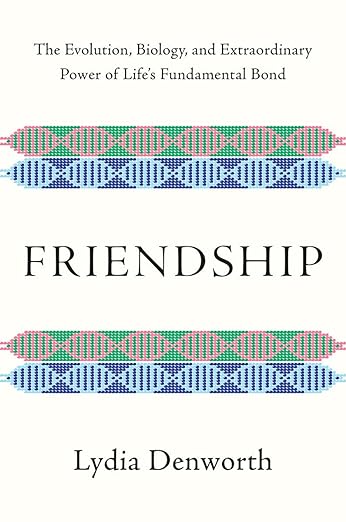
 In now the sixteenth month of my unusually isolated lifestyle, following a general history of being not outgoing whatsoever, I find myself reading more about social connections, either why we need them or how to forge them. This led me to Lydia Denworth's 2020 book Friendship: The Evolution, Biology, and Extraordinary Power of Life’s Fundamental Bond, audiobook narrated by Tiffany Morgan.
Though I've read a lot of popular nonfiction about human relationships, most of those books have been more on the social science side of things. This introduced me to research I was unfamiliar with. One finding: friends have brains that process the world the same way. It turns out that we do not all experience music in the same way, for instance. Friends are more likely to have similar brains that lead them to enjoy the same types of music. Or put another way, shared interests are more than just superficial commonalities. They speak to similar brain structures. I find that many of these books are written by extroverts who just...don't quite get it. I like extroverts. Some of my best friends are extroverts! But I am not sure I trust the social advice of people who understand the words "dinner party" beyond the abstract. My other frustration was that discussion of social media was shoved into one chapter, as though it were still a niche consideration in friendships. And within that chapter, the advice was that social media should supplement friendships, but that you should spend more time with people in real life. Excuse me, I am right here! Excuse me! Of course I would prefer local friends. Spending time in the same room is valuable, even if you're just hanging out instead of talking. Also there are certain activities that cannot be managed satisfactorily without proximity. But the author seems unaware that many friendships start online. My closest friends are people I have not met. Not met yet, rather. I want to read one of these books written by someone who is Very Online. These mild concerns notwithstanding, I enjoyed the book. I broadly recommend it, because social connections are so important for a healthy and happy life, for all of us, even the hermit-in-the-snowy-woods types like me.
0 Comments
|
Book talks
When Covid first hit, I started doing book talks on social media as a way to keep in touch with people. I never got out of the habit. I don't discuss books by my clients, and if I don't like a book, I won't discuss it at all. While I will sometimes focus on craft or offer gentle critical perspectives, as a matter of professional courtesy, I don't trash writers. Unless they're dead. Then the gloves come off. Archives
February 2024
Tags
All
|
 RSS Feed
Proudly powered by Weebly