
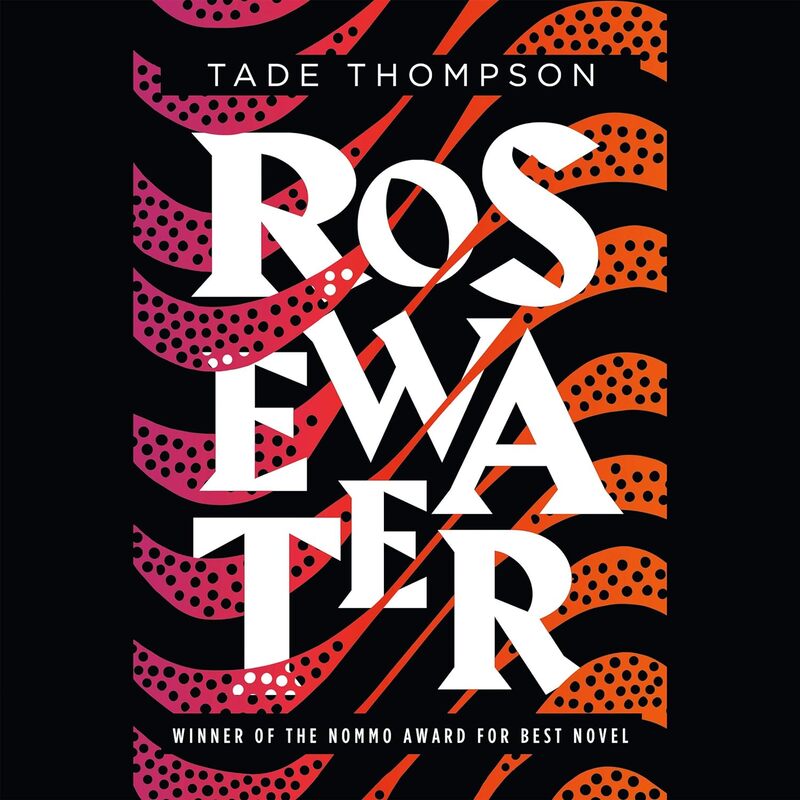
 Tade Thompson’s Rosewater is one hell of a book, science fiction plus thriller plus horror. The prose is superb and the characters are uncommonly well developed.
There is so much plot going on here, so much, that I will not attempt a plot summary. It’s the year 2066, the aliens have landed in Nigeria, and consequently a few people are psychic now. That’s all you need to know. One scene stopped me in my tracks, and I do mean that literally. I was walking Revvie and when I finished listening I stopped, said “Holy shit” aloud, and rewound to listen again. For those who’ve already read it, I am of course referring to the part where the starving carnivorous floating alien gets loose. Last time I read a scene that good was in Cormac McCarthy’s The Road, when the father and son stumble across the horror basement. That’s the level of Holy Shit I’m talking about. The main character, Kaaro, is a dickhead. That’s also a risky move, but I hope I’m making clear that Tade Thompson has the storytelling chops for it. I’d also like to point out that we follow each other on Bluesky, which makes us best friends, basically. The prose is excellent. That’s the most important thing to me in any book, the wordsmithing. And the audiobook is a joy. I just looked up the narrator to confirm that Bayo Gbadamosi is from Nigeria, surely he must be with that accent but nope, he was born in London. Anyway the narration is terrific, though at some point I need to go back and read the book in print. What with all various times and dimensions and plot line, I need to be able to flip back and forth on the page. If violence is difficult for you to read, this is not the book for you. Cannot overstate that enough. I’m normally unfazed by fictional violence, but woof, this book got my attention. I learned about a form of death involving tires and unfortunately there is no way to unlearn that. I will have this knowledge forever. Also skip this book if you don’t like reading hot alien sex. Otherwise, strongly recommended.
0 Comments
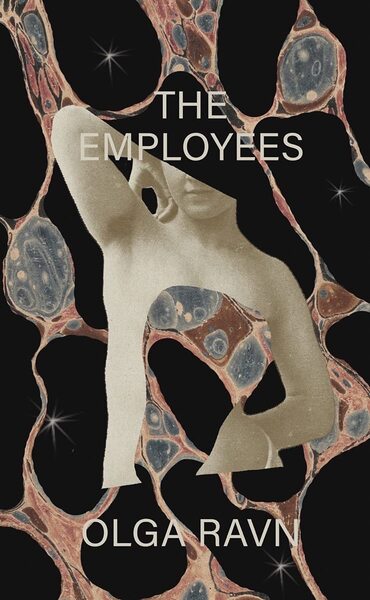 I read The Employees, a science fiction novel written by Olga Ravn, translated by Martin Aitken, and narrated by Hannah Curtis. First, a discursion. When discussing books, I go light on plot summary. A summary can tell you what happens, but that’s not a good indicator of whether you’ll enjoy the book. Better to describe the qualities of the plot. Are scenes action-packed with explosions and space lasers? Rooted deeply in the thoughts of a character? Predictable or experimental? Defined or ambiguous? Is the plot even the main appeal of the book? That’s common with commercial fiction, less common with literary fiction, and often irrelevant with nonfiction. Cookbooks don’t have plots. This logic sort of applies to music, too. “The Devil Went Down to Georgia” is a plot-driven song about good v. evil (though let’s be honest: the devil kicked Johnny’s ass in that duel). “Louie Louie” is about gibberish. 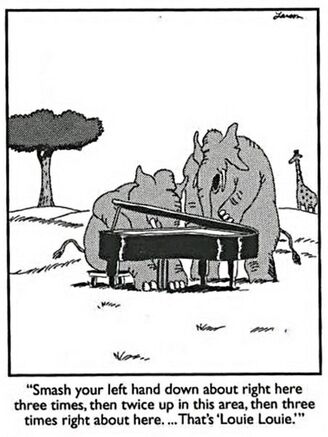 Other elements can be more important than plot. Character is the other big one. I don’t especially care who gets murdered or whodunnit; the reason I enjoy Agatha Christie is because of Hercule Poirot.
Setting can be a major appeal factor. When I read historical fiction, it’s usually because I’m interested in that era or location. And for me, the single biggest factor is the prose style (and illustration style for graphic novels). I care more about how the story is told than what story is being told. George Saunders, who gets my vote for best contemporary American wordsmith, wrote a book of literary criticism and I devoured it. No one goes around devouring Harold Bloom. At least I hope not. Thank you for indulging my two-hundred-word excuse for not describing the plot of The Employees. I didn’t follow what was going on. I enjoyed the book, but I’m not real sure what it was about, beyond humans and humanoids interacting with alien objects on a space ship. Nor can I name a single character. In The Virgin Suicides, Jeffrey Eugenides uses a collective narrator, a technique that left me feeling off kilter. Same disconcerted feeling here. I never got my bearings. But I enjoyed it! The book was atmospheric and moody and weird, more literary than I normally go for, but it was a short book so I felt willing to try something strange. I didn’t love it, the way I adored the atmospheric and moody and weird writing of Jeff VanderMeer’s Annihilation or Susanna Clarke’s Piranesi, but I’m glad I spent time in that world. 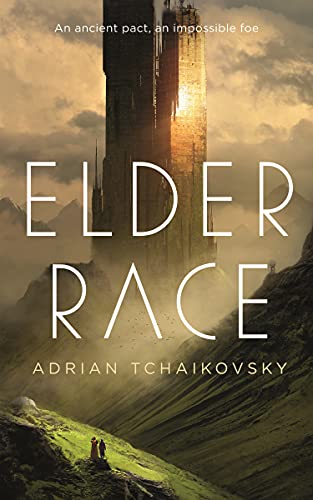 I draw a distinction between good writing and good storytelling. Not every author is good at both, and commercial publishing favors the latter. Plot-driven books sell better than language-driven.
Personally, I look for strong, competent prose. I don’t need ornate language or undreamt-of metaphors, but I will stop reading for mechanical clumsiness: overusing dialogue tags, slipping artlessly into comma splices, beating that subject-verb-object triple play for every dang sentence. Adrian Tchaikovsky delights on both counts, writing and storytelling. He’s best known for his Children of Time series, but I got started with Elder Race, a quick read with excellent audiobook narration by John Lee. It’s a perfect genre blend of fantasy and science fiction. An overlooked younger princess goes on a hero’s quest to find a wizard to save the realm from a demon. The wizard is in fact an anthropologist second class, living out whole centuries in suspension while he waits for his fellow scientists to retrieve him from his outpost. It hits all my favorite notes: thoughtful internal character development, adventure tempered by human politics, magic clashing with technology. And no goddam romance. Sorry—but I don’t like love stories in my fiction. That’s a tender spot for me. The depressed and lonely weird wizard dude with literal horns growing out of his forehead, thanks to futuristic body mods, does not end up with the courageous and beautiful young woman. Like they don’t even flirt. It’s wonderful. There are any number of reasons why you might not like a genre. I just explained why I don’t like romance novels, so I’m in no position to hector anyone about not reading science fiction or fantasy. But if the reason you abstain is because you’re only familiar with shoddier examples, I’d invite you to give speculative fiction another go. This one will only take a few hours of your time. 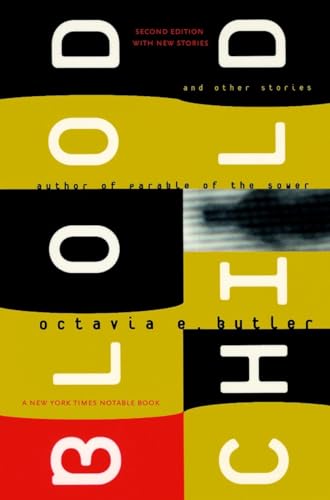 Bloodchild collects seven stories and two essays by Octavia Butler. She died in 2006 but remains a fixture of science fiction and fantasy.
Of these stories, my favorite was “Amnesty,” about humans adapting to extended-stay alien visitors. The story invites you to consider if and how you would resist invasion. The whole story was strong, but the last couple of lines left me all shook up. But all of the stories are strong, with themes of illness and alien encounters show up repeatedly. And the essays are about Butler’s life and her thoughts on writing. They’re lovely. I quite enjoyed the audiobook as narrated by Janina Edwards. It’s a quick listen or a quick read, and a good entry for readers who aren’t familiar with Butler. 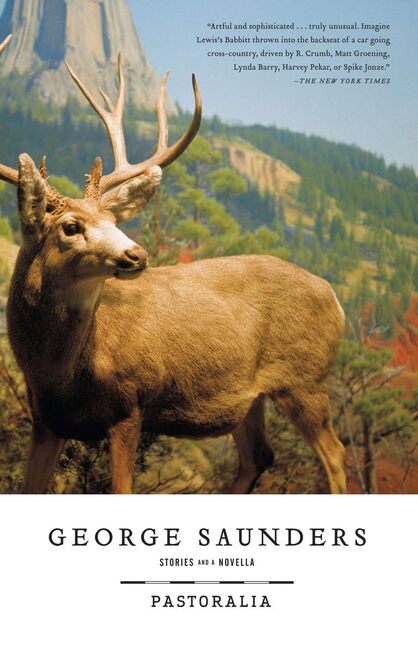 George Saunders is the best contemporary American writer, an opinion I feel more comfortable holding following the deaths of first Toni Morrison and then Cormac McCarthy.
Unusually among successful writers, his primary medium is short fiction. He’s only got the one novel, Lincoln in the Bardo, which is so good that he should probably stop there. Pastoralia is his second collection of short stories, published in 2000. Prose craft is different from storytelling. Being good at either one of these things is uncommon. Each Saunders sentence writes is a gem, but handled in such a lowkey way that you don’t realize you’re reading a master. You’re too focused on turning the pages because you need to know what happens next. Though if you enjoy audiobooks, I would implore you not to turn the pages but to listen to Saunders narrate his own work. The thing about Saunders that too many reviews miss is that he’s funny. Uproarious. The man is funny in print, but I listened to the book and I was howling. Also: when you listen, you can’t look ahead to know when a story is about to end. Three different times in this book, a story ended and I gasped out loud in shock. There are only six stories so that is a fifty percent gasp rate. My favorite story was “Pastoralia,” about some historical reenactors, but the one I’m going to quote from is “Sea Oak,” in which an elderly aunt bullies her nephew (a sex worker) into earning more money: “Show your cock. It’s the shortest line between points.” 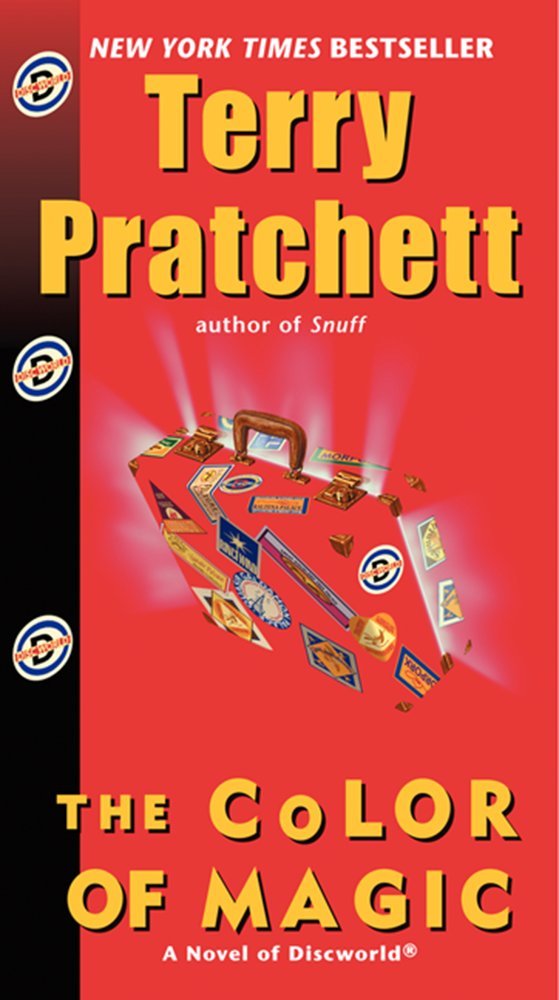 After seventeen years, I’m rereading Terry Pratchett’s Discworld series, and I hope you’ll consider joining me. These are books that will make you feel better. You will leave them knowing more about yourself and other people, and you will feel less pessimistic about everything.
I’m reading these in chronological order, which is why I’ve got Color of Magic up first, but that’s not where I recommend people dive in. With more than forty books in the series, there are a ton of great entry points, since few of the books depend on familiarity with prior entries. I do think the stand-alones are less intimidating, perhaps. Small Gods is my standard recommendation. But let’s not sweat the details. If you’ve never read Pratchett and you were waiting for a sign, hello, here it is, the universe would like you to read a Discworld book. The Color of Magic introduces us to the greatest city on the Disc, Ankh-Morpork, and its least talented wizard, Rincewind. Until I moved to a state with unjustly few characters allowed for license plates, my license plate read WIZZARD in homage to Rincewind. In some ways he is my favorite Discworld character, not because he is the best, but because I imprinted on him like a duck. I’m not doing anything like a coherent plot summary, but that’s not the point. No other author’s death has affected me more than Pratchett’s. That’s what his books have meant to me, and so many other people, but I am afraid if I keep on in this vein I will sound like a religious fanatic. Occasionally I’ll be discussing these books on Sundays (the new Day of the Week for these weekly book talks), or they might come midweek if I’ve got another book to discuss on Sunday. But I will write about each one. I intend to read a bit of Pratchett each day until I have finished the series, however many months or years that takes. 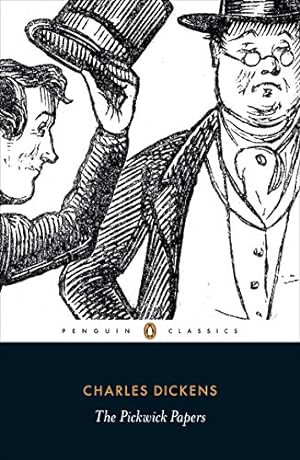 While the rest of you are enjoying Charles Dickens the way God intended, with Muppets, I am here finishing up the first Dickens novel, The Pickwick Papers, serially published in 1836-1837. It follows the adventures of an English gentleman named Pickwick and several of his fellow gentlemen. I cannot overstate how boring these adventures are.
Forgive me. I do not typically speak ill of works by living writers, and even though Dickens is safe from my literary criticism, there are plenty of you out there who like this book, and here I am being unkind to it. I am sorry. I would like to hear what it is you like about it. The book is a series of linked vingettes. Many of them feel frivolous. It is true there are moments of depth, but the first time I said "Ah, now we're getting somewhere" was p. 564, which is fairly late in the game for a plot to thicken Pickwick gets himself thrown in debtors' prison, and for a few blessed pages, Dickens writes with the social consciousness that elevates him above so many other writers. That passage would be enough to radicalize anyone into becoming a prison abolitionist. Regrettably, I cannot speak with such fervor about the remaining 700ish pages. There are also footnotes and appendixes but I have only one wild and precious life. A couple of years back I listened to an audiobook version of The Christmas Carol. It's in the public domain, so there are quite a few voice actors to pick from, but I quite enjoyed the narration by Tim Curry, and that's what I might recommend before the Pickwick Papers. 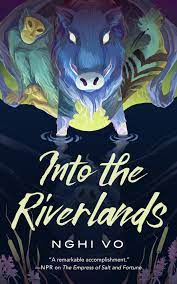 I talked about Nghi Vo's fantasy series The Singing Hills Cycle a few months ago. The books follow a cleric named Chih, whose religious order focuses more on history than faith. In this third entry, Into the Riverlands, Chih is once again traveling the land, looking for stories to collect. If you haven't read the first two, that's fine. Each novella stands independently.
Vo's prose style is quite good, and her storytelling is masterful. You don't know the details of the plot, going in, but you recognize right away that you're in for a good story. It's a blend of adventure and magic with a setting that recalls the hinterlands of Imperial China, only gayer. Vo's characters express a variety of genders and sexual orientations. And while there are lots of sections with fast action and tense battles with bad guys, the book has a contemplative feel. By which I mean I cried several times. 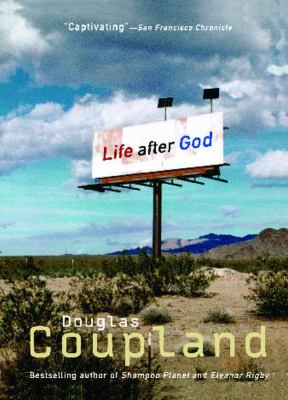 Douglas Coupland's 1994 novel Life After God is super weird. It's about going going though normal adult stuff. Like many works of literary fiction, the plot is not really the main point, though I do not wish to imply that this story lacks in action. The scenes with the exploding nuclear bomb are pretty quick paced if that is important to you.
I want to say that this is a book about finding community and connection even in an isolated world. Now granted I am suspiciously able to find those themes in every book I read, but in this case the reviewer blurbs back me up. This book is dangerously quotable. A few instances: "His main pick-up technique was to pump out negative signals so that women with low self-esteem would be glued to him." "Before we know it, too much time has passed and we've missed the chance to have had other people hurt us. To a younger me this sounded like luck; to an older me this sound like a quiet tragedy." "As I--we--get older, we are all finding that our conversations must be spoken. A need burns inside us to share with others what we are feeling. Beyond a certain age, sincereity ceases to feel pornographic." Coupland's writing reminds me of Russell Banks, with the shrewdness of the main character's perceptions. And I think it's not too much of a stretch to compare this book (it really is weird) to The Little Prince, though it's less whimsical and more the-march-of-time-comes-for-us-all. Also there are lots and lots of little pictures throughout the book, which is pretty great, more books need this please. 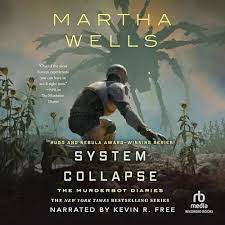 System Collapse, the latest in the science fiction series of novellas-approaching-novels by Martha Wells, was released four days ago. I did extra housework to get in the listening time so I could discuss it today. My floors are looking nice.
Murderbot is a security unit, a construct of human and machine parts. Its job is to provide security to a group of human researchers, who keep getting into mortal peril when they visit other planets. Its likes include watching soap operas. Its dislikes include getting attached to humans, who are messy and complicated. Narrator Kevin R. Free does such a good job with this series. I am especially fond of the voice he does for ART, the sentient research vessel that steals every scene it's in. I'm almost as fond of ART as I am of Murderbot. Don't tell Murderbot I said that. Don't start with this one of you're new to the Murderbot Diaries. Go back to the beginning with All Systems Red. I realize I haven't said anything about this book specifically. I don't think I'll go into plot details, but I'll say that it made me feel some feelings the same way poor Murderbot felt them. "I was having an emotion, like a big, overwhelming emotion. It felt bad but good, a weird combination of happy and sad and relieved, like something had been stuck and wasn't stuck anymore. Cathartic, okay? This fits the definition of cathartic." |
Book talks
When Covid first hit, I started doing book talks on social media as a way to keep in touch with people. I never got out of the habit. I don't discuss books by my clients, and if I don't like a book, I won't discuss it at all. While I will sometimes focus on craft or offer gentle critical perspectives, as a matter of professional courtesy, I don't trash writers. Unless they're dead. Then the gloves come off. Archives
February 2024
Tags
All
|
 RSS Feed
Proudly powered by Weebly