
|
Today is American Thanksgiving, a holiday mired in whitewashed politics and history. I’m trying to unlearn the propaganda I imbibed as a child, trying to teach myself indigenous history.
So here I am reading a book by a *checks notes* white man…? It’s a classic in the field. The way our systems and education and history have shaped things, most classics in most fields are written by white men. William Cronon’s Changes in the Land: Indians, Colonists and the Ecology of New England (1983) is a seminal work of ecological history. Cronon studies how natives interacted with the natural environment and compares it to European interactions. It’s a short book, but dense. I listened to the audiobook, narrated by Bob Souer, and I will confess I zoned out at times. But the gist is: European-style, balls-to-the-wall exploitation of the land is not sustainable. Your crops will fail if you keep planting the same seeds on the same fields, year after year. Your multiplying sheep will trample the ground, compacting the soil so they have to graze further and further afield. There is more subtlety in this book than “Natives good, Colonizers bad,” but I have to say, the Europeans don’t come out looking great. Also they were shit at honoring treaties. I’m glad I read the book, since it is a foundational text of ecological history, but it was a slog. I used to have patience for academic writing. It was necessary when I was an undergraduate history major. I am losing that patience as an adult.
0 Comments
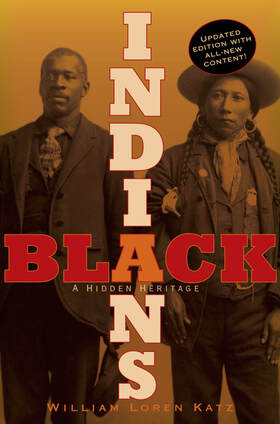
I listened to Black Indians (1986; rev. 2012), written by William Loren Katz and narrated by Bill Andrew Quinn. It examines the intersection of Black and indigenous cultures in North America and what would become the United States.
Okay, I just looked it up and Katz died in 2019 (age 92!) so it won’t hurt his feelings if I criticize the book a little. I was hoping for more discussion of the broader themes of race and culture, but that is perhaps a contemporary bias. I shouldn’t expect much sociology in a forty-year-old history book. A kinder perspective would be to appreciate that Katz, a white man, did scholarship about minoritized groups well before that was common in the literature, even if it does wander sometimes into the noble savage stereotype. Katz is strongest when speaking about individuals. Of the people he describes, three stand out:
|
Book talks
When Covid first hit, I started doing book talks on social media as a way to keep in touch with people. I never got out of the habit. I don't discuss books by my clients, and if I don't like a book, I won't discuss it at all. While I will sometimes focus on craft or offer gentle critical perspectives, as a matter of professional courtesy, I don't trash writers. Unless they're dead. Then the gloves come off. Archives
November 2025
Tags
All
|
RSS Feed